


From sewer cleaning trucks to concrete pumps, many heavy vehicles power their equipment through a split shaft PTO. How does it work, and why is it chosen?
Many heavy vehicles need engine power not only to drive but also to run the equipment they carry. The high-pressure pump of a sewer cleaning truck, the suction unit of a vacuum tanker or the hydraulic system of a concrete pump all draw their power from the vehicle's engine. The system that transfers this power from the engine to the equipment is called a PTO (Power Take-Off).
What makes a split shaft PTO different?
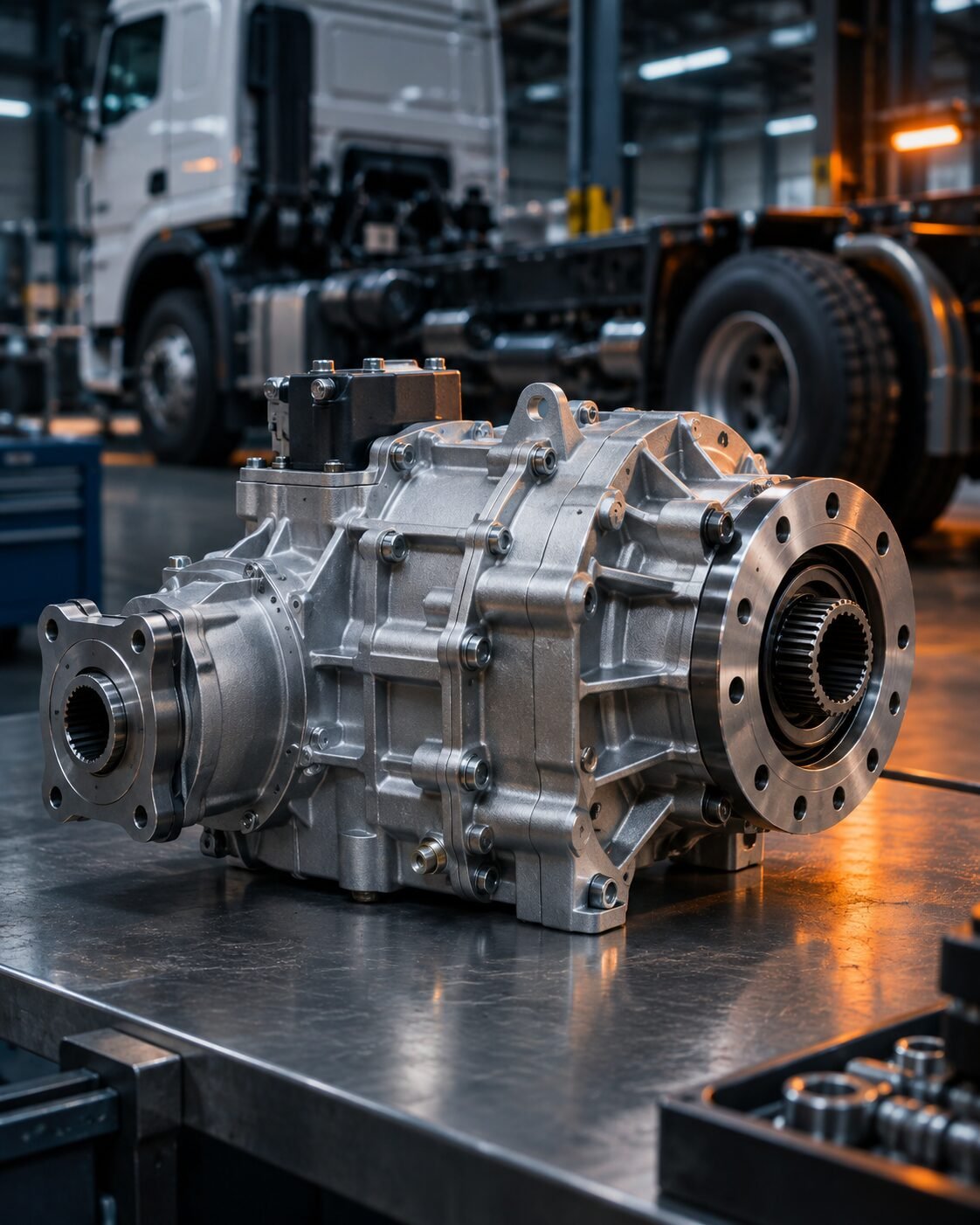
Conventional PTOs mounted on the side of the gearbox can transfer only limited power. In high-power applications, the PTO is installed in the driveline between the gearbox and the rear axle: the driveshaft is "split" and an intermediate gearbox is placed in between. That is where the name split shaft comes from.
This design allows nearly all of the engine's power to be directed to the equipment while the vehicle is stationary. When the vehicle is on the road, the intermediate gearbox simply passes the power through to the differential.
The basic principle
- Drive mode: Power flows from the gearbox through the intermediate gearbox to the differential, and the vehicle moves normally.
- Work mode: The control system separates the power flow from the drive line and directs it to the service outputs, i.e. the pumps.
- Control: Switching is usually done from the cab through a pneumatic mechanism.
How to choose the right PTO
The key factors are torque capacity, the number and direction of service outputs needed (differential or cab side), the pump connection type, cooling requirements and the sensors to be used. For example, our CAS20 series offers 2200 to 2900 kgm and our CAS30 series 3800 kgm of capacity.
To find the right configuration for your application, explore our split shaft PTO products or contact our engineering team.
More articles
See all
Rooftop solar for businesses: where to start?
A rooftop solar plant is one of the most tangible ways for industrial facilities to cut energy costs. Here are the first steps towards a sou...
Hot Shift: engaging the PTO without touching the main clutch
An intermediate gearbox with Hot Shift lets you engage and disengage the PTO without the main clutch pedal. That small difference means real...